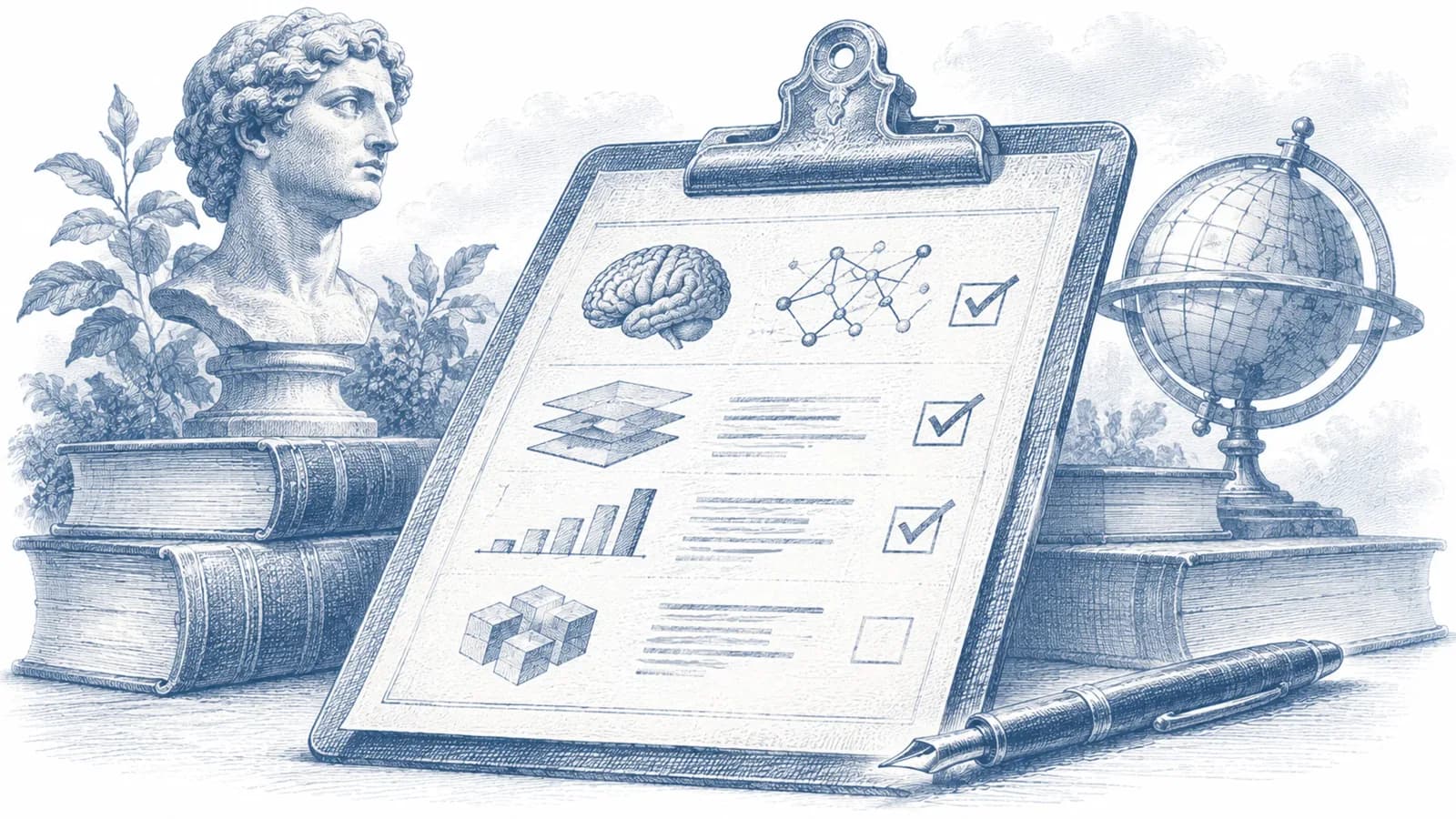
An AI talent assessment is a way to evaluate how well a person works with AI on the kind of tasks their role involves. The useful version does not ask people what they know about AI. It watches what they do when an AI assistant gives them an answer, and scores the decisions they make.
The phrase is used in two ways, so it is worth separating them. Some people mean using AI software to screen candidates. This guide is about the other meaning: assessing people, candidates or employees, on their ability to work with AI. That is the question most hiring and talent teams now need answered.
Why resumes and interviews miss AI talent
Almost every resume now lists AI skills, and almost every candidate can describe a prompt they wrote. Neither tells you what happens when the AI is confidently wrong. Two people can hand in work that reads equally well, where one checked the numbers and the other pasted the first answer.
That difference is invisible in a document and hard to surface in conversation. It only shows up when you observe the work. This is the gap an AI talent assessment is meant to close. For more on why usage is a poor signal, see usage vs capability.
What an AI talent assessment should measure
Tool knowledge goes out of date quickly. The habits behind good AI-assisted work do not. Answerr measures five of them:
- Judgment: evaluating AI output before acting on it, and knowing what should not be delegated.
- Reasoning: working through incomplete or conflicting information to a decision the person can defend.
- Critical thinking: checking claims and catching errors, even when the answer sounds convincing.
- Adaptability: rethinking the approach when new information arrives.
- Questioning: asking questions that clarify the problem and move the work forward.
Together these describe AI capability: how a person works with AI, not how often they use it. The full breakdown is in the AI capability framework.
How to run an AI talent assessment
1. Use a task from the role
A finance analyst should work on a forecast, a customer success lead on a renewal. Generic puzzles tell you little about how someone will perform in the job.
2. Give everyone the same task and the same AI
Comparison only works when the conditions are the same. If each person uses a different tool on a different problem, you are comparing the setups, not the people.
3. Include moments where the AI is wrong
The most informative moment in a session is when the AI makes a confident mistake. Whether the person notices, checks and corrects it tells you more than the final answer does.
4. Score the process against published criteria
Record what the person asked, what they verified and what they decided, then score it against criteria you can show them. A score without evidence is an opinion. Answerr publishes its method in how AIQ is measured.
5. Keep a human in the decision
An assessment result is one input. Use it to decide what to ask next, alongside experience, interviews and references.
Using it for hiring and for existing teams
In hiring, the assessment fits after the first screen and before final interviews. The shortlist completes the session, and the report gives interviewers specific moments to ask about. The step-by-step version is in hiring with AIQ.
For an existing team, the same approach gives you a baseline: who is strong, where the common gaps are and whether training changed anything when you measure again. See the AI readiness assessment for how that works across a workforce.
What to avoid
- Multiple-choice quizzes about AI facts. They measure recall, not work.
- Self-rated confidence surveys used as the only signal. Confidence and performance often differ.
- Penalizing people for using AI. Using it well is the skill being measured.
- Scores with no evidence behind them. If you cannot show why someone got a result, you cannot defend the decision.
- Treating one session as a verdict on a person. It is a record of one piece of work.
Where to start
If you are comparing options, how to choose an AI skills assessment tool lists the questions to ask a vendor. If you want to see what a session looks like before involving candidates, the interactive demo lets you work one decision with an AI colleague and then shows the report a hiring team would receive.
Frequently asked questions
What is an AI talent assessment?
It is an evaluation of how well a person works with AI on tasks from their role. A good one observes the person working with an AI assistant and scores their judgment, reasoning, critical thinking, adaptability and questioning, with evidence for each score.
Is an AI talent assessment the same as using AI to screen candidates?
No. Using AI to screen candidates means software evaluates applications. An AI talent assessment, as described here, evaluates the person's own ability to work with AI. The two are often confused because the phrase is used for both.
How is it different from an AI skills test?
An AI skills test usually checks knowledge of tools or prompt techniques. An AI talent assessment looks at how someone works through a realistic task with AI, including what they do when the AI is wrong.
When should candidates take an AI talent assessment?
After the first screen and before final interviews. At that point the shortlist is small enough to justify the time, and the results give interviewers specific things to ask about.
Can it be used for current employees?
Yes. Running the same assessment across a team gives a baseline, shows where the gaps are and lets you measure again after training to see what changed.